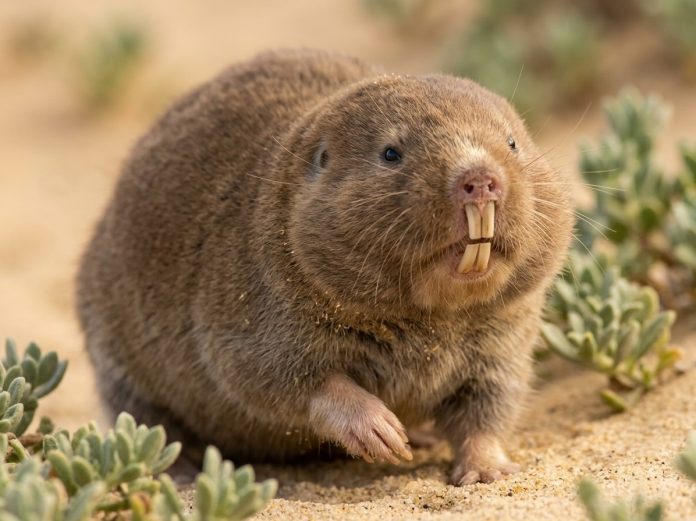
If you’ve ever watched your respectable garden acquire little sand mountains overnight, you may have met the Cape dune mole-rat. And while gardeners may regard these furry excavators with a grudge, Bathyergus suillus is actually doing rather useful work beneath our feet.
Despite its common name, this isn’t a mole. It’s a rodent—a large, solitary member of the blesmol family Bathyergidae—and one of the West Coast’s extraordinary underground specialists.
Built like a furry torpedo, it has a chunky cylindrical body with a dense and silky cinnamon-brown coat, short legs, a broad, flattened head and small eyes with poor eyesight. External ears are absent, while its short, bristly tail is an afterthought. Equipped with powerful, curved claws, the forefeet are formidable digging implements. But it’s the enormous incisors, which grow continuously, that do most of the excavation.
Dune moles certainly aren’t social butterflies and spend almost their entire life beneath sandy soils, solitary and territorial with individual burrow systems. They feed exclusively on roots, bulbs, grasses and other vegetation.
Breeding is seasonal, with females producing one to six young. Meanwhile, males have the curious courtship ritual of drumming their hind feet underground.
The inconvenient truth for gardeners is that these irritating little excavators are ecosystem engineers. Their burrowing alters soil structure, increases humic content and can improve water infiltration and the soil’s ability to hold water. So the next time a dune mole leaves a mound on your lawn, take a deep breath. It’s not vandalism. It’s landscaping.