Beautiful, blustery and steeped in stories, Bloubergstrand has never been tame.
One of the Mother city’s great theatrical stages, Bloubergstrand—literally blue mountain beach—is mountain, sea, sky and wind arranged in sync. But beneath all that beauty lies a rather more turbulent history.
Way back when, the Goringhaikonas lived in this landscape. Their leader Autshumao—later known to colonial chroniclers as Harry die Strandloper—became one of the Cape’s most fascinating early intermediaries between indigenous communities and arriving Europeans. Taken to Java to learn English, he later acted as interpreter and messenger for the ships calling at the Cape, earning a place in history as South Africa’s first postmaster.
Then came 1806 when Blouberg’s horizon was filled with cannon smoke. Geopolitics defined the Battle of Blaauwberg. Britain wanted control of the Cape because it was a crucial maritime stepping stone enroute to India. The Batavian administration, tied to Napoleonic France, had other ideas. British troops landed along the coast and clashed with the Batavian forces of Lt-General Jan Willem Janssens. The fighting itself was brief. However, the consequences were anything but. The British victory led to the permanent transfer of the Cape Colony to British control, altering the political and cultural trajectory of southern Africa for generations.
Blouberg’s coastline has seen its share of wrecks and maritime calamity. During the great storms that periodically turned Table Bay into a watery tantrum, ships were dragged from their anchors, smashed onto reefs and deposited on beaches in various states of nautical embarrassment. After all, the Atlantic is known for having absolutely no manners.
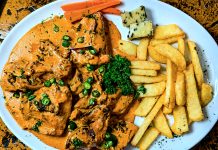
At the end of Stadler Road stands another witness to the area’s layered past: Ons Huisie, one of Bloubergstrand’s oldest surviving dwellings. Once home to Frederick Louis Stadler, whose family owned much of the surrounding land, the little whitewashed building has survived long enough to become something of a local institution. Today, it serves food rather than shelter.
There are ghosts here too. A phantom ship is said to have drifted offshore before dissolving into the mist. Shadowy figures have reportedly crossed the dunes along the R27, appearing briefly and then vanishing into the landscape.
And yet Bloubergstrand is not a museum, nor a mausoleum for old battles. It remains gloriously alive. Fishermen still work the waters when conditions allow. Mussels, seabirds, seals and, in season, passing whales remind visitors that this coast doesn’t only belong to humans with expensive sports equipment.
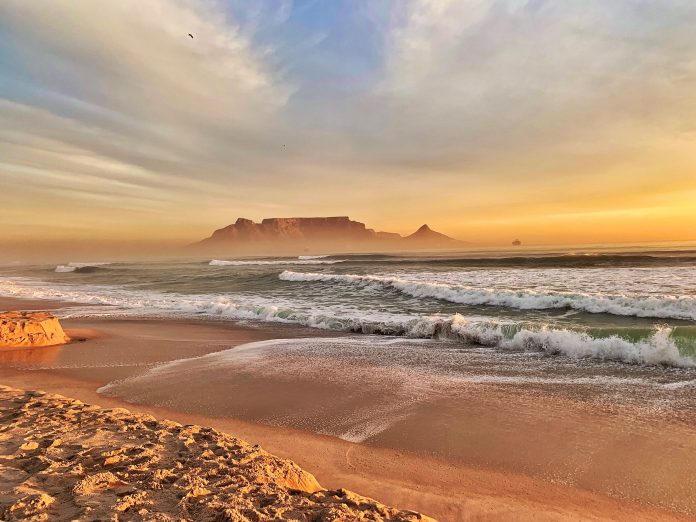
Then, of course, there is that view: Table Mountain across the bay, Robben Island on the horizon, a white beach and flickering kites. Simply stunning!
Photo: Ference Isaacs