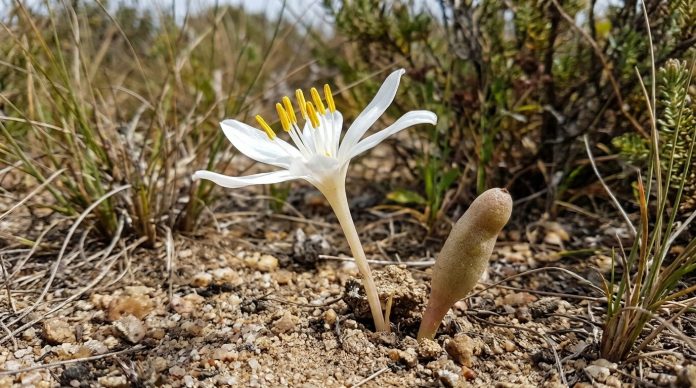
A botanical marvel hidden beneath the West Coast sands.
Sculpted by elemental forces unlike anywhere else, our seemingly endless West Coast nurtures a handful of rare marvels found only in this stubborn corner of the world. Among these is the koekemakranka, also affectionately known as the sandman, veld banana or Christmas star (Gethyllis spp., Amaryllidaceae). This extraordinary bulb is one of our signature geophytes.
Its curious name has inspired many stories. One explanation traces it to the Khoi word khû, meaning “thorn”, a reference to the finger-like fruits that thrust through the sand. Others link it to an old expression for curing an ailing stomach.
The koekemakranka is a botanical marvel—a plant so extraordinary it borders on the magical. Yet, like so many of our indigenous treasures, it has long been plundered by collectors as far back as the late 18th century. Thus, once an eagerly anticipated marker of the West Coast seasons, koekemakranka time now lingers more in memory.
The genus Gethyllis occupies a curious niche within the elegant amaryllis family. No fewer than 37 species are known: each producing its own distinctive flower, most often white, adorned with brilliant yellow stamens and a graceful central stigma.
Every bloom is a six-pointed star, yet no two are quite alike. Some wear long, slender petals spaced delicately apart; others unfurl broad petals that overlap like fine porcelain. The more delicate species produce clusters of long-stemmed blossoms, often blushed with pink or traced with the faintest rose-coloured veins. Their sturdier cousins carry stout, almost stemless flowers, borne singly or in generous bunches. Even the plants’ trademark twisted leaves vary from one species to another.
These small distinctions make species such as the graceful, rough-leaved Bokkeveld koekemakranka readily recognisable to those who know where—and when—to look. However, flowering is unpredictable. Different species bloom between October and February, while their fruits emerge over a staggered season.
Each koekemakranka has evolved to suit its chosen patch of earth with remarkable precision. Some thrive in deep, well-drained coastal sands; others favour mineral-rich shale, ironstone clays, granite outcrops or quartz-strewn slopes. Hidden safely below ground, the robust bulb stores enough moisture to weather long dry spells.
The plant’s greatest marvel is its impeccable sense of timing. Research has revealed that each stage of its life depends on a precise environmental cue. A sudden drop in atmospheric pressure sets the next act in motion. The koekemakranka lives according to an elegant three-part rhythm: leaves in winter, flowers in summer, fruit in late autumn and early winter.
During winter, its beautifully twisted leaves emerge from the sand like delicate green eyelashes. As spring advances, the leaves wither away, leaving the bulb dormant beneath the earth. Then, from November onwards, the atmosphere changes. Pressure falls, and almost overnight exquisitely scented white stars burst into flower. Their performance is heartbreakingly brief. Within only a few days the blossoms fade, with the Cape’s desiccating berg winds often bringing the curtain down even sooner.
Once pollinated, the real magic begins beneath the soil. The ovary slowly swells underground for three or four months before finally pushing its fruit into the open when the rains arrive. The result is a banana-shaped berry—sometimes reaching 14 cm in length—its skin coloured honey-brown, golden yellow or deep crimson, depending on the species. Packed with rows of tiny speckled seeds, each fruit possesses its own distinctive shape, colour and perfume. Tough-skinned, it announces its arrival with an irresistible fragrance.
Humans are only one member of an appreciative audience. Tortoises, porcupines, mice, sheep and birds all relish the aromatic fruit. Celebrated Hantam poet, physician and gourmand C. Louis Leipoldt even recorded a recipe for koekemakranka liqueur. Among those who knew the veld well, simply steeping the fruit in brandy was tonic enough.
The plant’s perfume once served purposes beyond the table. Veld bananas were hung in wardrobes and bedrooms to sweeten the air, while infusions of the fruit or flower petals were brewed as traditional remedies to ease stomach complaints or aching teeth.
It’s a sadness that both this remarkable plant and the intimate knowledge surrounding it are steadily slipping from memory.
Translated and abbreviated from a wonderful piece written in Afrikaans by Dr Pieter van der Walt of Melkbosstrand.